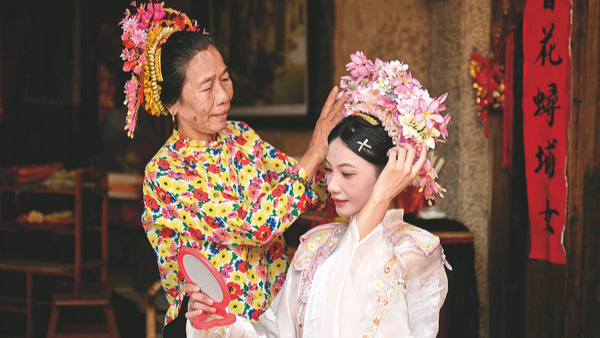
Xunpu floral headdress
Introduction
The Xunpu floral headdress, known as zanhua or zanhuawei, is a distinctive cultural artifact originating from the fishing village of Xunpu in Quanzhou, Fujian province, China. This traditional headpiece, characterized by its vibrant floral arrangements, is worn by the women of Xunpu and has become a symbol of their enduring cultural identity. The floral headdress serves not only as an adornment but also as a representation of hope, happiness, and the resilient spirit of the Xunpu women. With its roots tracing back over 800 years, the Xunpu floral headdress remains an integral part of the village's customs and is celebrated for its aesthetic beauty and cultural significance.
Historical Background
Xunpu village, situated about 10 kilometers southeast of Quanzhou city, has a rich history as one of the key ports along the ancient Maritime Silk Road. As such, it has been a melting pot of cultures and traditions, which have influenced its local customs, including the floral headdress. The practice of wearing floral headdresses by women in Xunpu dates back over 800 years and has been passed down through generations. This tradition was officially recognized as a form of national intangible cultural heritage in 2008, highlighting its historical and cultural value. The village's history is deeply intertwined with the sea, influencing the lifestyle and cultural expressions of its people.
Cultural Significance
The Xunpu floral headdress holds significant cultural value as it embodies the aspirations and resilience of the women in the village. It is a symbol of beauty, hope, and happiness, reflecting the women's love for life and their wishes for a prosperous future. The floral headdress is an essential part of the traditional attire worn during various cultural and religious ceremonies, reinforcing its role in community identity and cohesion.
Symbolism
The floral headdress symbolizes various aspects of life in Xunpu. It represents the beauty and vitality of the women who wear it and serves as a reminder of the community's collective heritage. The use of fresh flowers signifies renewal and the cycle of life, while the intricate arrangements highlight the creativity and artistry of the local women. The headdress is also seen as a talisman, believed to bring good fortune and happiness to the wearer.
Occasions for Wearing
The Xunpu floral headdress is traditionally worn during important occasions such as weddings, festivals, and religious ceremonies. One notable event is the annual Mazu Temple celebration, where women don traditional costumes and floral headdresses to seek blessings from Mazu, the goddess of the sea. These occasions offer an opportunity for the community to come together and celebrate their shared cultural heritage.
Design and Craftsmanship
The creation of the Xunpu floral headdress involves a meticulous process that combines traditional craftsmanship with artistic flair. Each headdress is a unique work of art, reflecting the skill and creativity of the maker.
Materials Used
The materials used in crafting a Xunpu floral headdress include both natural and artificial elements. Real flowers, such as peonies, lilies, camellias, magnolias, and chrysanthemums, are traditionally used for their vibrant colors and symbolic meanings. In modern times, a combination of real and artificial flowers may be employed to enhance the durability and appearance of the headdress. Additionally, greenery or fabric serves as the base for arranging the flowers, while ribbons and hairpins are used to secure the headdress in place.
Techniques
The techniques involved in creating a Xunpu floral headdress are rooted in age-old traditions passed down through generations. The process begins with tying the hair into a bun using a red ribbon, symbolizing unity and perfection. Flowers are then carefully selected and arranged in cascading layers, creating a colorful and harmonious ensemble. The arrangement requires skillful handling and creativity to ensure that the flowers complement each other and the overall aesthetic of the headdress.
Modern Influence
In recent years, the Xunpu floral headdress has experienced a resurgence in popularity, both within China and internationally. This renewed interest has led to contemporary adaptations and efforts to preserve the cultural heritage of Xunpu.
Contemporary Adaptations
Contemporary adaptations of the Xunpu floral headdress have emerged in response to changing fashion trends and the increasing demand for personalized styles. Simplified versions of the headdress have been designed to accommodate different hairstyles and preferences, making it more accessible to a broader audience. These adaptations maintain the essence of the traditional design while incorporating modern elements to suit current tastes.
Cultural Preservation Efforts
Efforts to preserve the cultural heritage of the Xunpu floral headdress have been spearheaded by local artisans and cultural enthusiasts. Initiatives such as workshops, exhibitions, and social media campaigns aim to educate the public about the history and significance of the headdress. These efforts have not only helped sustain the tradition but have also attracted tourists and cultural scholars to Xunpu, contributing to the village's cultural and economic revitalization.








